

Acceptance and Commitment Therapy (ACT)
Living a meaningful life alongside difficult thoughts and feelings
Acceptance and Commitment Therapy (ACT) is an evidence-based therapy that helps people build psychological flexibility — the ability to stay present and engaged in life even when difficult thoughts or emotions show up. Instead of trying to eliminate, change, or control your uncomfortable internal experiences, ACT helps you change your relationship to them. The goal is to stop wasting energy fighting painful feelings and instead use that energy by taking action toward what truly matters to you. It invites you to build a rich, meaningful life—regardless of what uncomfortable emotions show up along the way.
ACT is highly experiential, practical, and grounded in mindfulness and commitment to action. It is supported by a robust and growing body of research and has repeatedly been shown to be effective for anxiety, depression, chronic pain, trauma, and stress-related concerns, often yielding better outcomes than standard care or no treatment.
Core Processes in ACT
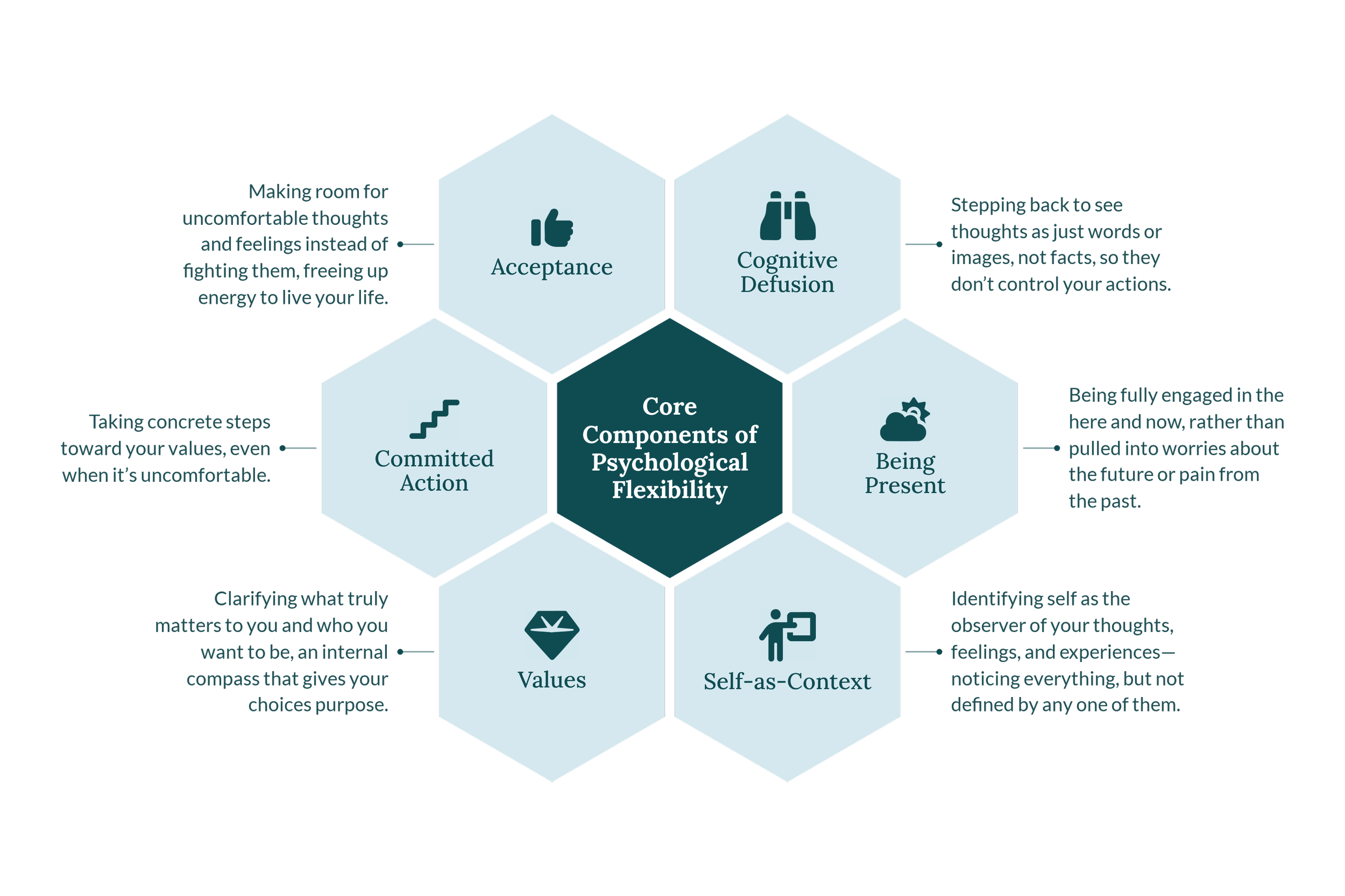
ACT is built around six interconnected processes — often referred to as the “Hexaflex.” These processes work together to increase psychological flexibility, or the ability to stay present, open, and engaged in life even when difficult thoughts and emotions show up. One-on-one sessions are collaborative, experiential, and focused on applying skills directly to your daily life by utilizing metaphors and mindfulness practices.

The “Hexaflex”

Acceptance
Making room for uncomfortable thoughts and feelings instead of fighting them. By dropping the struggle against your pain, you free up energy to focus on living your life.
Cognitive Defusion
Learning to step back and see your thoughts as just words or images, not absolute facts, so you can them from controlling your actions.
Present Moment Awareness
Strengthening the ability to be fully engaged in the here and now, rather than getting pulled into worries about the future or painful experiences from the past.
Core Components of Psychological Flexibility
Self-as-Context
Developing a sense of self as the observer of thoughts, feelings, and experiences — the part of you that notices everything, but is not defined or limited by any single experience.
Values
Clarifying what truly matters to you and defining who you want to be. They act as your internal compass, guiding your choices and giving your actions a sense of purpose.
Committed Action
Taking concrete steps toward your values, even when it's uncomfortable.

Another Way to Think About ACT
The processes that support change in ACT can be understood through the metaphor of a trellis in a garden. Your life is the garden, and your values are what you are trying to grow and nurture. Thoughts, emotions, and difficult experiences are part of the natural environment — like weather and weeds — and they cannot always be controlled or removed. ACT is not about creating a perfect, problem-free garden, but about learning how to use supports, like a trellis, to foster growth even in imperfect conditions. The ACT processes function like a trellis that helps guide and stabilize growth, allowing you to stay connected to what matters most while moving through whatever shows up along the way.
What does a typical session look like?
-
Sessions often begin with a brief mindfulness practice — grounding you in the present moment before you begin the deeper work.
-
You and your therapist explore what's been showing up — difficult emotions, thoughts, or situations — and how you've been responding to them.
-
You work on one of the six ACT processes — for example, practicing "defusion" by noticing a difficult thought and observing it without getting tangled in it.
-
You reconnect with your values: what kind of person do you want to be? What matters most to you, underneath all the struggle?
-
Together, you identify one small action you can take before the next session that moves you toward what you value — even if you feel afraid.

Experience particularly intense or overwhelming emotions
Find yourself easily flooded by life events
Grapple with impulsive choices or reactions
Navigate frequent conflict or instability within relationships
Find it difficult to regulate your emotional responses
Feel trapped in patterns of self-blame, avoidance, or shame
Live with persistent stress or anxiety
Have a history of self-harming, suicidal thoughts, or risky behaviors
Worry about being left or abandoned
Feel disconnected from yourself or paranoid under pressure
Lack clarity regarding your current feelings or their origins
Experience uncertainty about your identity, values, or life path
Prefer a structured approach with concrete tools

Who benefits most?
ACT may be especially helpful for:
“Thinking Out of It" Trap: Those who have tried to intellectually think their way out of difficult feelings and found it doesn't work.
Unresolvable Pain or Grief: People navigating chronic pain, chronic illness, or deep loss where the source of suffering cannot simply be removed.
Anxiety, Depression, & Burnout: Anyone struggling with OCD, chronic stress, or feeling constantly overwhelmed by life.
Loud Inner Critic: Anyone feeling controlled, paralyzed, or consumed by self-judgment.
Ready for Experiential Work: People open to mindfulness and practical exercises rather than just talking.
Feeling Stuck: Redefining what matters most and taking meaningful action to live fully, despite ongoing difficulties.
If you've spent a lot of energy fighting your emotions or trying to feel happier before taking committed action towards the life you want — ACT flips that script.
ACT is also worth exploring if you feel disconnected from what matters to you, or if life has narrowed because you've been avoiding discomfort. The key is openness to a new way of relating to your inner world.
-
Harris, R. (2019). ACT made simple: An easy-to-read primer on acceptance and commitment therapy (2nd ed.). New Harbinger Publications.
Hayes, S. C., & King, G. (2024). Acceptance and commitment therapy: What the history of ACT and the first 1,000 randomized controlled trials reveal. Journal of Contextual Behavioral Science, 33, Article 100809. https://doi.org/10.1016/j.jcbs.2024.100809
Hayes, S. C., & Strosahl, K. D. (Eds.). (2004). A practical guide to acceptance and commitment therapy. Springer. https://doi.org/10.1007/978-0-387-23369-7
Hayes, S. C., Luoma, J. B., Bond, F. W., Masuda, A., & Lillis, J. (2006). Acceptance and commitment therapy: Model, processes and outcomes. Behaviour Research and Therapy, 44(1), 1–25. https://doi.org/10.1016/j.brat.2005.06.006
Hayes, S. C., Strosahl, K. D., & Wilson, K. G. (2011). Acceptance and commitment therapy: The process and practice of mindful change (2nd ed.). Guilford Press.
Ong, C. W., Ciarrochi, J., Hofmann, S. G., Karekla, M., & Hayes, S. C. (2024). Through the extended evolutionary meta-model, and what ACT found there: ACT as a process-based therapy. Journal of Contextual Behavioral Science, 32, Article 100734. https://doi.org/10.1016/j.jcbs.2024.100734 Cited by: 80
Powers, M. B., Zum Vörde Sive Vörding, M. B., & Emmelkamp, P. M. (2009). Acceptance and commitment therapy: A meta-analytic review. Psychotherapy and Psychosomatics, 78(2), 73–80. https://doi.org/10.1159/000190790

Ready to begin?
Taking the first step is the hardest — and the most important.
A free 15-minute consultation, no pressure, no commitment.
Schedule a consultation today.